
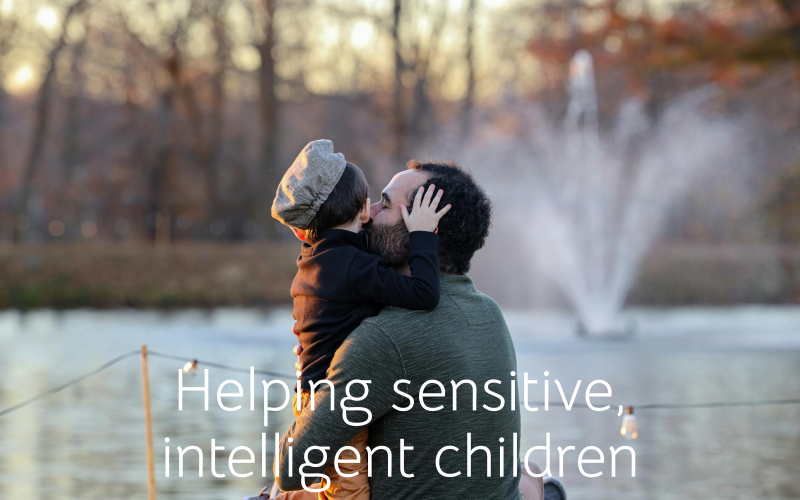
Helping sensitive intelligent children
When it comes to helping sensitive, intelligent children, one of the most frequent questions I hear from people interested in my work is “do you work with children?”
I don’t – directly. I work with you. You’re (one of) the most influential people in your child’s life – and if you understand their sensitivity and intelligence, you can create way more practical change in your household than I can do by talking with your child. You can influence their routine, their environment, their inputs (TV, films, games, experiences of nature), who they hang out with…
I’m writing from the perspective of having been the sensitive, intelligent kid. The perspective of working with sensitive, intelligent adults for 10+ years, who were sensitive intelligent kids for a few years themselves, and what worked – or didn’t – for them. The perspective of a sensitive, intelligent parent to a sensitive, intelligent child.
So I do have quite a few things to say about sensitive, intelligent kids that may be of use to you. Actually, I have some things to say about you with regard to your sensitive, intelligent kids. Namely:
Get the foundations right :-)
Secure attachment is the foundation for an enormous range of physical, emotional and mental capabilities and experiences. Secure attachment builds through the the natural bonding instinct and process between humans. Usually it refers to the infant – nurturer bond, but it can also form between adults later on.
The security your child finds in you, when you’re a a reliable, available, and generally positive person that they can attach to – an attachment figure – gives them the foundation they need to venture confidently out into the rest of the world, and a safe haven to come back to when they need it. These are essential for building, for example, emotional processing skills, self-regulation, and their own sense of self-regard as they grow independent of you.
An insecurely attached child generally has lots of difficulties in different spheres, as a child, and as an adult. Insecure attachment is linked to higher incidence of unhappy relationships as an adult, anxiety, withdrawal, depression, addictions, vulnerability to stress, and more. It’s a mess – and as an adult you can heal from a starting point of insecure attachment.
Before I carry on, I’ll say this first: adults, who were insecurely attached as children, are almost certainly insecurely attached as adults. All is not lost – there are ways to recover, reparent yourself, and readjust to it. But know that life’s a heck of a great deal more straightforward if you start off securely attached: what you do as a parent/caregiver has long-reaching effects and can save – or cause – your child a lot of hassle further down the line.
Sensitive kids are more affected by poor quality relationships than non-highly sensitive kids. An insecurely attached child who is also sensitive/intelligent will be more affected by the poor attachment relationship than a non-highly sensitive/intelligent child. They have more going on with regard to their sensitivity and/or intelligence, and are more affected by the absence of a secure foundation on which to stand when processing the intensity and enormity of their highly sensitive/intelligent experience of themselves and the world. One plus one does not equal two here.
The attachment bond has four aspects to it:
Secure base
The attachment figure is a secure base from which the child can go out to explore the world.
Safe haven
The attachment figure is emotionally available to the child, and provides help and comfort when required by the child, in the way that the child needs it. The attachment figure does not abuse the child, whether physically, emotionally, verbally, sexually, or in any other mode.
Availability / proximity maintenance
The attachment figure is physically available to the child and the child acts to stay close (enough) to them.
Separation distress / separation anxiety
The child becomes upset, stressed, anxious or otherwise distressed when separated from the attachment figure. This will show in different ways at different ages.
The key is helping sensitive intelligent children feel safe enough that they can bond securely enough with you. You know your kids: you know what makes the smile and shine, you know what makes them wither and retreat, you know what makes them explode with joy, sorrow, frustration, excitement. Be – or become – aware of them and how they tick. Aim for the good in them and you.
Be physically available to them. Make time for them – they need you. Not you on your smartphone -they need you, all of you, on the sofa, or surfboard, or swamp-walking with them. (Is swamp walking even a thing? I seriously hope so.)
Be emotionally available to them. If this is not (yet) your forte, find a counsellor who can help you become more aware of your own emotional experiences, and better able to manage your emotional life (n.b. shutting off your emotions does not count as managing them well!!) and your kids will benefit from your new skill too.
Be honest and appropriate. Don’t burden them with the stresses of your day, but also don’t try to mask it when you’re stressed as heck and need a minute to lie on the floor to gather your remaining ounce of cool so you can handle the rest of your family time together (trust me, it helps). Help them to understand that emotions are a normal and essential part of being human, that managing emotions is a skill that can be learned through theory and practice, and that some people have smaller emotional amplitudes, while others have humungous emotional amplitudes that need a heck of a lot more patience, skill and courage in handling. (I’m looking at you, Mrs Quiet-but-so-intense-inside-it’s-almost-thermonuclear-in-there).
Be mentally available to them. Learn about sensitivity, intelligence, and how to handle them (Great that you’re here! Keep reading!) so you have the mental models at your disposal to understand your child’s experience and to help them to understand themselves – or find them someone who can understand them. Know that sensitivity can go way beyond the five standard senses and emotions into the realms of the intuitive, empath, psychic, medium, energy sensitive, and others. Know that science knows what science has so far been able to measure and analyse, and that the tendency of the scientific community can be driven by the fundamentalists (in the sense of those who are fundamentally skeptic, rather than open-mindedly skeptic and ‘we don’t know yet’).
Be interested in what they’re interested in. You’ll learn from them.
If you think you’ve totally messed up and missed the boat on helping your kids to bond securely with you: find a counsellor or therapist who specialises in attachment therapy! Seriously, this is one of the quickest methods, with the right therapist for you and your situation. The slower routes will involve you reading lots of books, going to occasional workshops, piecing together your own roadmap, observing your kids lots, observing yourself and other key adults, learning how to deeply self-reflect (which is quite a thing if you’re not already self-reflective at this level), changing your behaviours in small and/or large ways, et cetera, et cetera. It will require more effort, more time, more money, more everything.
If your parents/caregivers messed you up (quite probably unwittingly, in many cases) in the attachment department, get some therapy. Attachment therapy, or other therapy/ies that can help you to create a sense of safety, reliability and availability in yourself, to yourself. Go at it on all fronts, so to speak. Physically: run, cycle, dance, do yoga, tai chi, sail, surf, whatever – be in your body and move. Physical therapy/ies: massage, cranio-sacral, whatever floats your boat. Floatation tanks. Saunas, steam rooms, long hot baths. Emotional nurturing. Mental nurturing. Read books that nourish you. Spiritual nurturing. Meet the needs now that didn’t get met then. Talk to me – working with gifted, sensitive people is my jam.
If you messed up and your kids are now adults – kudos to you for reading this. Read more about it. Educate yourself. Grieve the childhood you didn’t give them, grieve the parenting you didn’t experience. Get yourself a counsellor who can hold space for you to navigate your own experiences, and help you find better ways to connect with your adult children.
If you’re in a long-standing family pattern of crappy attachment – your parents, their parents, you, your kids, and so on – ancestral healing would be worth a go, to help you disentangle from generations-old patterns and focus your efforts more on the here and now, rather than be affected by the there and then that was.
And breathe. There’s a lot on this page that, if it’s pertinent to you, will touch you. It may move you – now or later. Allow yourself time to digest, reflect, ponder. And nurture yourself. We all need a lot more of that going on.
What next?
1. Do Nothing
Always an option. But if you’re a concerned parent (or in a parent-adjacent role) to a sensitive, intelligent child, the impulse to Do Something About It is probably there. In which case…
2. Do-It-Yourself
There are plenty of useful books, websites, programmes, workshops, retreats and more to help you identify, understand, manage, and improve your parenting.
You might enjoy my free course on grounding – a fundamental skill to keep yourself anchored in and open to your experience. There’s a lot to be said for practising grounding and being able to do that *in the middle of a heightened moment* with your child and help *both* of you restabilise. Read about what it is to be Ungrounded then sign up for your free copy of my Grounding Course, with a guidebook and guided audios if that takes your fancy.
You can also get new articles and updates from me direct to your inbox. Sign up here:
3. Do It With Someone
I offer 1:1 support to adults to help you understand and help your sensitive intelligent child(ren). Contact me if you’d like to work with me to support you (and through you, your child).